>

Your application estate
has an engine room.
Nobody in your organisation
has ever looked inside it.

ERP Structural Intelligence  ·  Complexity Governance

STRATA™ gives CIOs, CTOs and boards the first independent structural intelligence layer for complex application estates — SAP, Oracle, Microsoft, Infor, Epicor, Sage, QAD, Baan, and legacy environments including AS/400, iSeries, COBOL, FoxPro, and Access. Measure what you have. Govern what compounds. Modernise on a stable core.

Avoid the programme you don't need.
Your ERP estate is more complex than anyone in your organisation knows.
Modernisation does not fail because systems are old.
It fails because complex systems are accelerated before they are stabilised.

Every release cycle adds structural weight to your estate. None of it is being measured. None of it is being reversed. The cost accumulates until a programme forces the conversation — at which point it is already expensive. If a migration, a programme commitment, or a board governance review is on your horizon, the structural picture comes first.

Explore the Platform →
<48h
First Structural
Complexity Index
0
Write events
to ERP
Days
Edge™ app
to production
10
Platform
modules
STRATA™ · SCI Dashboard · Indicative Estate Scanning
Structural Complexity Index (SCI)
58
Entropy Velocity Index (EVI)
+2.3
Custom Objects Mapped
14,830
Peer Benchmark Percentile
72nd
Dormant Objects Identified
3,420
T4 Critical Integration Nodes
7
Built for legacy estates
SAP Legacy
ECC6 · R/3 · On-Prem ERP
Microsoft Legacy
AX · NAV · GP
Oracle Legacy
EBS · JDE · PeopleSoft
Infor & Mid-Market
LN · M3 · Epicor · Sage · QAD · Baan · IFS
Homegrown & Proprietary
AS/400 · iSeries · COBOL · FoxPro · Access DB
Response to assessment request
<1 business day
01
The Structural Flaw

Four problems.
Every mature estate.
No exceptions.

These are not edge cases. They are the structural reality of every legacy application estate in operation. The last problem — the one nobody in the organisation will name out loud — is the one compounding the fastest.

10–30%
Of custom objects confirmed dormant
on first STRATA™ scan — in every estate,
without exception.
Zero structural visibility before onboarding.
No estate has ever arrived already mapped.
P.01
The Estate Has Never Been Mapped

Nobody knows how many custom objects exist, how deeply they intertwine, or which ones still serve a purpose. Every release adds weight — objects, modifications, dependencies — and nothing is ever removed. Every change is planned against an estate that is heavier than last quarter and less understood than the quarter before. Risk is guesswork dressed as estimation.

10–30% of custom objects confirmed dormant on first STRATA™ scan  ·  Entropy compounds every release cycle  ·  No estate has ever arrived already mapped
P.02
The Board Has No Structural Number

The CIO cannot tell the board how complex the estate is. Cannot measure whether it is improving or deteriorating. Cannot compare it to peers. Integration points grow organically — no register, no density map, no warning when a critical node becomes a single point of failure. Every governance conversation is narrative without evidence. The board knows this — even when it doesn't say so.

Zero board-ready structural metric before STRATA™  ·  200–400 undocumented integration points in a mature estate  ·  T4 critical nodes unidentified until mapped
P.03
Programmes Fail Before They Begin

Transformation programmes are planned, approved, and budget-committed before anyone has modelled the structural impact on the estate they are about to touch. Complexity surfaces mid-delivery. Overruns, rescoping, and missed milestones follow — not as surprises, but as structural inevitabilities that were visible before the first line of code was written.

Structural risk discovered at delivery, not at commitment  ·  No pre-approval complexity classification  ·  ChangeSimulate™ closes this gap before the board signs off
P.04
The Backlog Is Permanent — By Design

Every business requirement — a field app, a customer portal, a document workflow, an approval chain, an AI agent — joins an IT backlog. The core cannot change fast enough. The business waits. Months become quarters. Competitors who have structurally separated innovation from the core are not waiting. This is not a resourcing problem. It is an architecture problem. And it compounds.

Solved by STRATA™ Edge™  ·  Build above the core in days, not quarters  ·  Zero new objects added to the ERP core  ·  Web, iOS, Android from one configuration
·
The Structural Alternative

Your ERP doesn't need to be replaced.
It needs to be governed.

Thousands of enterprises are running mature ERP estates under significant pressure — from vendors, from boards, from peers who appear to have already moved. Most believe their only options are migrate or fall behind.

There is a third path.

It starts with understanding what your estate actually is before making any decision about what to do with it.

The Reality

The anxiety is real — and some of it is manufactured

End-of-maintenance deadlines. Competitors who appear to have modernised. Boards asking why the organisation hasn't moved. The quiet career risk of being on the wrong side of a transformation decision. These pressures are genuine — but the timeline driving them is being set by vendor sales cycles, not by your estate's structural readiness. End-of-support dates across all major ERP platforms have been extended repeatedly. The urgency is a commercial lever. The complexity is real.

The Asset

Your ERP is a capital asset, not a liability

Most mature ERP estates are fully or near-fully depreciated. They carry 15 to 25 years of embedded operational logic — custom process flows, configuration, integrations — that have evolved to match actual business behaviour. That logic functions. It runs the organisation every day. The governance question has never been asked: what is this estate actually worth, what complexity does it carry, and what would it cost to replicate elsewhere? STRATA™ answers that question before any decision is made.

The Business Case

The migration business case is systematically incomplete

Vendor TCO models exclude hyperscaler hosting, integration middleware, ISV licence realignment, and parallel-running costs during cutover. Migration programmes routinely run 3 to 5 times the initial estimate. Standardised cloud ERP is designed for the customer the vendor wanted — not for complex operational industries with legitimate process depth. Integration complexity is relocated, not resolved. And board-level scrutiny now requires a 7 to 10 year ROI horizon that most vendor business cases cannot credibly support.

Gartner estimates more than 10,000 SAP customers will continue to support major parts of their business on ECC beyond 2030. The urgency is a commercial lever. The complexity is real.
The Third Path

Govern, extend, modernise — without a programme

STRATA™ Intelligence maps the estate, scores its structural complexity, monitors entropy, and gives the board a defensible governance number. STRATA™ Edge™ delivers modern capability — mobile applications, customer and supplier portals, workflow automation, Business AI — built above the core with zero write events to the production ERP.

STRATA™ Intelligence
Govern the estate
STRATA™ Edge™
Modernise above it
0 Write Events
Core stays stable
When You're Ready

Migrate with structural evidence — not vendor pressure

STRATA™ does not tell you not to migrate. It tells you what you are migrating. A governed estate with a known Structural Complexity Index score migrates more successfully — fewer surprises, lower programme cost, fewer failure events. When your migration time comes, the structural map STRATA™ produces is the most valuable single input your system integrator will ever receive. Your timeline. Your board's decision. Not your vendor's sales quarter.

3–5×
Typical programme cost overrun without structural pre-assessment
7–10yr
ROI horizon boards now require to justify migration investment
15–25yr
Embedded operational logic the vendor TCO model does not price
<5%
Of pre-migration assessments are structurally independent of the vendor proposing the target architecture

"The organisation that understands its estate owns its decision.
The organisation that doesn't is managed by its vendor's sales cycle."

02
Platform Architecture

Two layers.
One platform.
Zero changes to the core.

STRATA™ operates as two complementary layers above your ERP. The structural intelligence layer observes and governs — read-only, non-intrusive, architecturally enforced. The Edge™ modernisation layer builds and executes — apps, automations, and Business AI and Co-Pilot capabilities deployed above the core without touching it.

Together they give the CIO complete structural visibility and complete digital velocity. The first answers the board's governance question. The second ends the IT backlog dependency.

STRATA™ — Observe & Govern
The structural intelligence layer reads metadata only. No business data accessed. No writes possible. Enforced at collector architecture — not by policy. First SCI computed rapidly — no human intervention required. Clean the pantry before you build above it.
Edge™ — Build & Execute
Once the estate is governed, Edge™ deploys the modernisation layer above it. No changes to underlying objects. No new ERP code. No structural footprint added. Build in days. Reach stakeholders directly — web, iOS, Android from one configuration.
Stakeholder
Layer
Customers Suppliers Employees Shareholders Regulators Investors
Engagement
Layer
Self-Service Portals Mobile Applications Collaboration Intranets Notification Channels Investor Comms
Business
Layer
Finance Supply Chain HR Operations Customer Compliance
STRATA™
Edge™
Build Layer Run Layer Sync Layer Business AI Mobile Apps Workflows
STRATA™
Intelligence
CorePulse™ CoreInsight™ Decomplex™ ControlPlane™ OperationsPlane™ StructureHistory™ ChangeSimulate™ BenchmarkIQ™ SCI · EVI · IDS · IVI · CVC · SHI
ERP
Core
Systems of Record
SAP ECC6 R/3 On-Prem
Oracle EBS JDE PeopleSoft
Microsoft AX NAV GP
Other Infor AS/400 COBOL
03
Platform Capabilities

Ten modules.
One governed
estate.

Ten modules, activated in engagement sequence. Each addresses a specific dimension of structural control. Together they deliver complete estate visibility, governance enforcement, and modernisation readiness — the full picture your board expects and your programme teams need.

M
Measure
R
Reduce
C
Control
M
Modernise
Module 01 · Pre-Engagement
CorePulse™
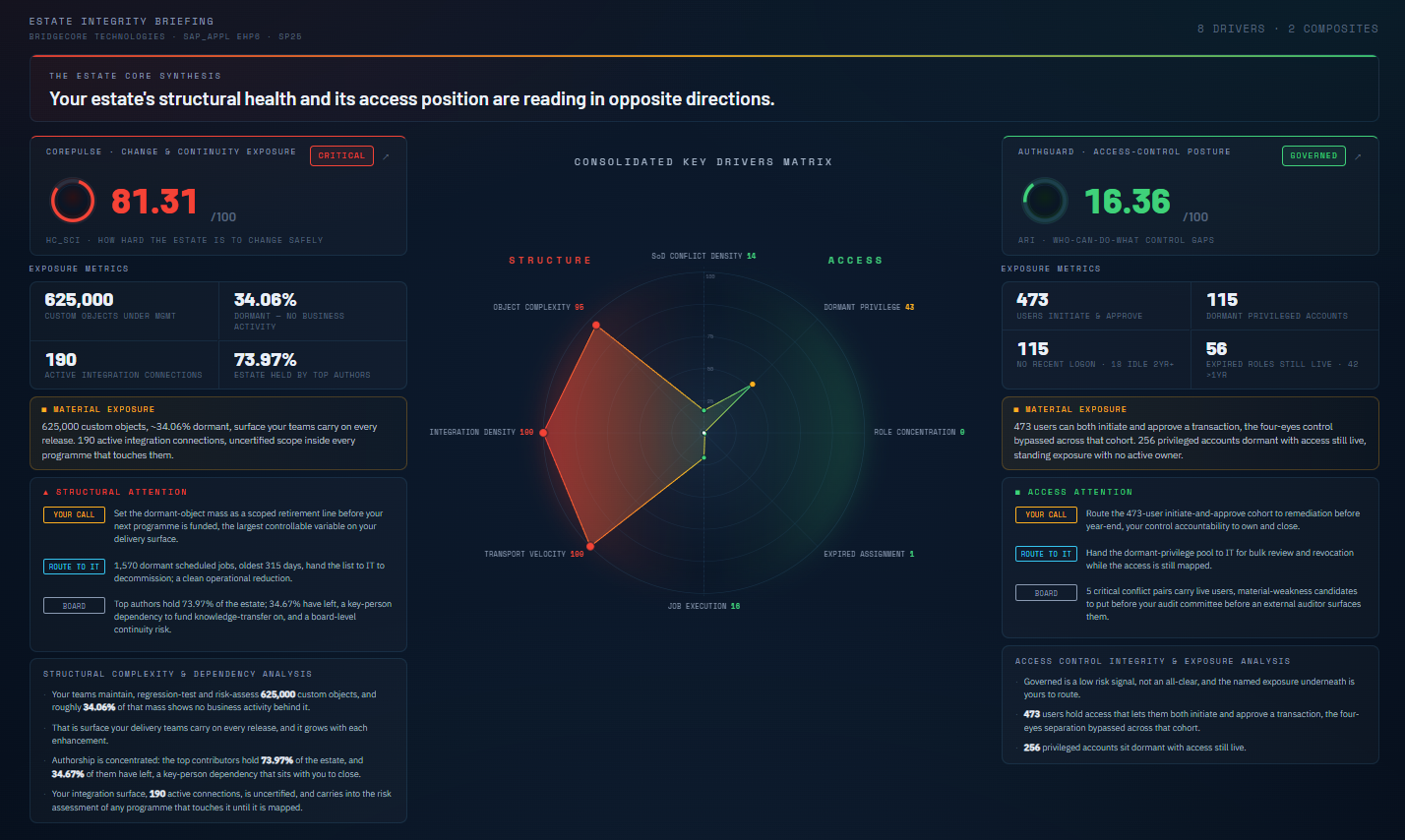
Pre-engagement estate scanner. Upload six standard SAP transaction exports via secure portal. Receive a Health Check SCI and signed Estate Health Report in seconds — no collector, no system access, no conversation required.
Explore module+
Pre-Engagement
CorePulse™

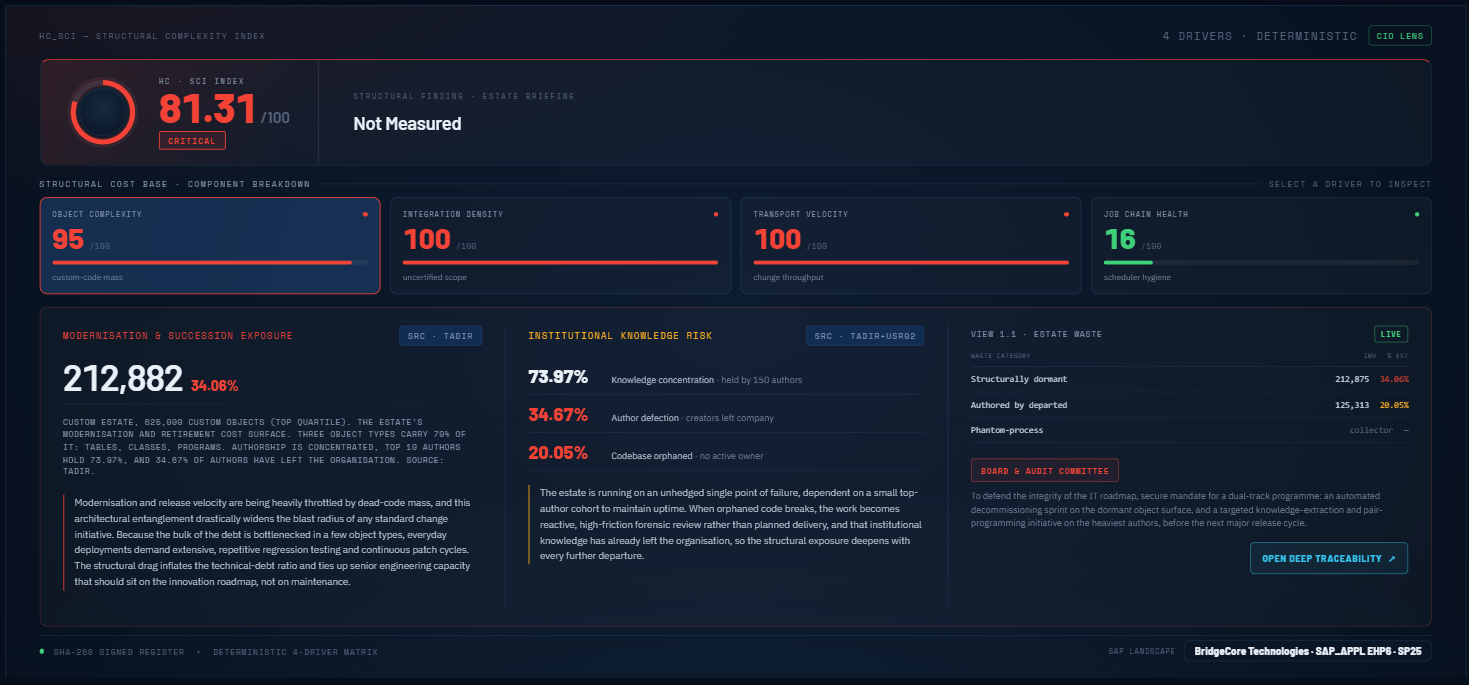
CorePulse™ is the entry point to BridgeCore Strata™. It requires no collector installation, no ongoing platform access, and no tenant provisioning. A prospect or partner uploads a small set of standard SAP transaction outputs via a secure portal. Processing completes in seconds.

The output is a Health Check SCI (HC_SCI) — a single-snapshot complexity approximation and signed Estate Health Report that tells the CIO, for the first time, what complexity class their estate falls into: GOVERNED, MANAGED, AT_RISK, or CRITICAL. No system access. No installation. No commitment required.

Standard SAP export files — a small set of standard transaction outputs available from any ECC6 system. No custom extraction, no BASIS involvement required.
Processing in seconds — HC_SCI computed and Estate Health Report generated in seconds from file submission. The portal key is invalidated after the first successful run.
Signed Estate Health Report — SHA-256 verified PDF containing the HC_SCI score, complexity band classification, plain-language Gap Statement, and a verification hash.
Dormancy signals detected — retirement risk indicators, integration density classification, and module-area utilisation patterns surfaced from the export set alone.
HC_SCI is a pre-engagement diagnostic — not a substitute for the full SCI computed by CoreInsight™. The distinction is explicit in every output.
Module 02 · Onboarding
CoreAssess™
Structured onboarding and configuration module. Conducts a six-section intake assessment with partner facilitation — no ERP connection required — and generates the configuration file that activates the CoreInsight™ collector.
Explore module+
Onboarding & Configuration
CoreAssess™

CoreAssess™ is the structured intake module that translates a client engagement into a precisely configured platform activation. It conducts a six-section assessment — covering ERP system identification, organisational context, operational scope, known pain points, assessment review, and collector configuration parameters — and generates the configuration file the CoreInsight™ collector requires to activate.

No ERP connection is required for CoreAssess™. The assessment runs in the BridgeCore portal with partner facilitation. The generated configuration always carries DRAFT status on generation — promotion to ACTIVE requires a partner-authenticated step. The writeEnabled parameter is hardcoded false in every generated file. It cannot be set to true by any input, parameter, or API call.

Six-section structured assessment — ERP identification, organisational context, operational scope, known complexity indicators, assessment review, and configuration parameters.
Configuration file generation — a validated platform configuration file encoding all collector parameters, schedules, thresholds, and scope definitions consumed directly by the CoreInsight™ collector.
Controlled activation — a partner-authenticated promotion step ensures no collector activates against a production environment without explicit partner review.
Zero ERP access required — CoreAssess™ is entirely portal-based. The ERP connection is established only after configuration is promoted to ACTIVE and the collector is deployed.
Module 03 · Foundation
CoreInsight™
The continuous structural visibility engine and platform foundation. Computes the full five-component SCI on every collection cycle. All downstream modules depend on CoreInsight™ data. Issues the Structural Baseline Certificate.
Explore module+
Continuous Structural Visibility
CoreInsight™

CoreInsight™ is the foundation of the platform — every other module depends on the data it produces. The lightweight collector agent deployed in the client network connects to the SAP system using a read-only service account and runs a structured extraction sequence on a configurable schedule. All SCI computation occurs in the BridgeCore cloud. No computation occurs on the collector host. No business data is ever extracted.

On completing the first collection cycle, CoreInsight™ issues the Structural Baseline Certificate — a signed, SHA-256 verified PDF that documents the estate's structural state at activation. This certificate is the governance baseline that the Edge™ activation gate requires before any modernisation layer may connect.

Full SCI computation — a multi-dimensional structural score normalised to a single 0–100 index, computed from proprietary structural metadata analysis across object, dependency, modification, and operational dimensions. GOVERNED / MANAGED / AT_RISK / CRITICAL band classification on every cycle.
Complete object catalogue — every custom object with its dependency graph, dormancy candidate classification, and integration record set, available via API and dashboard.
Structural Baseline Certificate — signed governance document issued after the first completed cycle. Required for Edge™ gate activation. Reissued quarterly with SHI included.
Structured extraction — object catalogue, dependency graph, and usage data collected via read-only outbound connections. No inbound connections to the client environment are permitted or required.
Null on absent inputs — if a mandatory input is unavailable for the current environment configuration, the SCI returns null. It is never estimated or approximated.
Module 04 · Reduce
Decomplex™
Structural entropy reduction engine. Three independent detection capabilities: dormancy detection, structural integrity analysis, and manual execution dependency detection. Produces EVI — the rate of entropy accumulation or reduction.
Explore module+
Entropy Reduction
Decomplex™

Decomplex™ operates entirely on data already held in the CoreInsight™ record set — no additional ERP extraction is required. It runs three independent detection capabilities and computes the Entropy Velocity Index (EVI) — the rate of SCI change per day, normalised against estate size. Positive EVI means the estate is accumulating complexity. Negative EVI means the reduction programme is working.

The average first-cycle Decomplex™ removes 18–24% of custom object footprint. Every reduction package includes reversal documentation. Nothing is executed without explicit client authorisation.

Dormancy detection — CONFIRMED, PROBABLE, and CANDIDATE tiers. Custom objects with no execution in the lookback period (default 365 days) classified by execution recency and dependency risk.
Structural integrity analysis — cyclic dependencies, orphaned objects, missing dependencies, dangling enhancements, and inconsistent package assignments detected and packaged for remediation.
Manual execution dependency detection — job chains, workflow steps, and integration sequences dependent on human intervention identified and flagged as operational fragility risk.
EVI trend line — available on every collection cycle. The primary evidence of an effective entropy reduction programme is sustained negative EVI tracked against governance thresholds.
Reduction packages with reversal instructions — every package includes a pre-action snapshot, candidate list, dependency risk assessment, and complete reversal documentation. Client executes. Platform recommends.
Module 05 · Govern
ControlPlane™
Hybrid execution governance layer. Maintains the automated integration registry, scores every node by density (IDS), classifies every change event by structural impact tier (CVC), and measures integration volatility (IVI) on a 90-day rolling basis.
Explore module+
Integration Governance
ControlPlane™

A mature ERP estate has between 200 and 400 integration points — most undocumented. ControlPlane™ builds and maintains the live integration registry automatically, populated within 72 hours of CoreInsight™ activation, covering RFC destinations, IDoc partner profiles, HTTP connections, SOAP/REST endpoints, and queue connections.

ControlPlane™ owns three governance indices: the IDS (Integration Density Score) per node, the IVI (Integration Volatility Index) on a 90-day rolling basis, and the CVC (Change Volatility Classification) applied to every detected change event. ControlPlane™ does not block changes — it classifies and alerts. Execution authority remains with the client.

Integration Density Score (IDS) — 0–100 per node, derived from connection count, call frequency, data volume, and criticality weighting. Nodes exceeding governance thresholds require mandatory dependency depth review before any change is committed.
Change Volatility Classification (CVC) — T1 (low) through T4 (critical). Deterministic tier applied to every change event detected in the integration estate based on IDS of affected nodes, dependency depth, and proximity to critical nodes.
Integration Volatility Index (IVI) — 0–100, 90-day rolling, weighted by change impact tier. When IVI exceeds governance thresholds, an integration freeze recommendation is issued to the client governance team — not an automatic freeze.
Guardrail alerts — configurable thresholds. When IVI or IDS Warning or Critical thresholds are breached, alerts are delivered to the client governance team. Feeds directly into ChangeSimulate™ for programme risk modelling.
Module 06 · Monitor
OperationsPlane™
Batch execution monitoring and pre-batch simulation. Detects failures within 60 seconds. Delivers a Pre-Batch Risk Report before every batch window opens. DUAL_LAYER mode models cross-layer dependencies between SAP batch and Edge™ workflows simultaneously.
Explore module+
Batch Governance
OperationsPlane™

OperationsPlane™ monitors SAP job scheduling and, where configured, Edge™ workflow execution simultaneously. It operates in three scope modes: SAP_ONLY, EDGE_ONLY, or DUAL_LAYER — with DUAL_LAYER modelling cross-layer dependencies between SAP batch output and Edge™ workflow sequences.

The Pre-Batch Simulation runs exclusively against historical data — it does not query the live ERP system or live execution queues at simulation time. Every recommendation requires a client decision. OperationsPlane™ is read-only throughout. It does not restart, reschedule, or cancel any job under any operating condition.

Continuous execution monitoring — failure, abort, cancellation, and runtime overrun detection. Alerts delivered within 60 seconds of detection at the 95th percentile.
Pre-Batch Risk Report — delivered before each configured batch window. Risk scores per job, dependency conflicts, resource contention. Client decides whether to proceed, defer, or modify.
Overnight Batch Summary — structured report available after each batch cycle completes. Feeds into StructureHistory™ for longitudinal operational trend analysis.
DUAL_LAYER mode — models cross-layer dependencies between SAP batch output and Edge™ workflow sequences. Critical for environments where Edge™ applications consume SAP batch outputs in near-real-time.
Module 07 · Intelligence
StructureHistory™
Structural trend intelligence engine. Converts the CoreInsight™ collection cycle history into an annotated longitudinal record. Computes the SHI — the board-level governance metric that summarises structural stewardship over the preceding 12 months.
Explore module+
Structural Trend Intelligence
StructureHistory™

StructureHistory™ converts the point-in-time SCI snapshots from CoreInsight™ into a longitudinal intelligence record. The Causal Annotation Engine correlates SCI movements with the transport releases, Decomplex actions, and enhancement changes that caused them — each annotated with a confidence score. Anomalous SCI jumps above five points are automatically escalated with a root-cause summary.

The Structural History Index (SHI) — computed quarterly — is the primary longitudinal governance metric for board-level reporting. It summarises four dimensions of structural stewardship: SCI trend direction, average EVI, Decomplex actions executed, and threshold compliance rate. SHI above 70 indicates a structurally well-governed estate.

Append-only structural history — every collection cycle state preserved for the client subscription lifetime plus 12 months. Corrections are written as new records — existing records are never modified.
Causal annotation — inter-cycle SCI movements correlated with transport releases, Decomplex actions, or enhancement changes. Confidence-scored. Labelled UNKNOWN when no contributing event can be identified.
Three-scenario SCI projections — Baseline (current EVI continues), Reduction (planned Decomplex actions executed), and Growth (historical release rate continues). Confidence-banded trend lines, not point estimates. 3, 6, and 12-month horizons.
Structural History Index (SHI) — quarterly composite score from SCI trend, average EVI, Decomplex action count, and threshold compliance rate. Included in the quarterly Structural Baseline Certificate reissue. Warning: below 55. Critical: below 40.
Module 08 · Simulate
ChangeSimulate™
Pre-change structural impact simulation. Model the projected SCI impact of a planned programme before budget is approved. GREEN / AMBER / RED classification against structural evidence — not delivery opinion.
Explore module+
Programme Risk Simulation
ChangeSimulate™

The defining failure mode of major ERP programmes is discovering structural complexity mid-delivery. ChangeSimulate™ eliminates it by modelling the structural impact of a proposed change on the live estate before the programme is approved. Simulations run entirely against historical CoreInsight™, Decomplex™, and ControlPlane™ data — no live ERP query at simulation time.

For AMBER and RED classifications, ChangeSimulate™ generates a Decomplex offset plan — a set of recommended reduction actions that could be executed before programme commencement to bring the projected SCI below the risk threshold. Back-test accuracy target: within 15% of actual SCI outcome against six historical collection cycles.

Change Scenario definition — planned new custom objects, modifications to standard objects, new integration endpoints, job chain additions, programme duration, and release cadence as simulation inputs.
GREEN / AMBER / RED classification — GREEN (projected SCI below 65), AMBER (65–80), RED (above 80). Tied to structural evidence from the live estate, not delivery confidence opinion.
Decomplex offset plan — for AMBER and RED simulations, a recommended set of reduction actions that could offset the projected SCI impact before the programme begins.
Board-ready programme risk brief — signed PDF for the steering committee, issued before programme approval — not at the first delivery review when surprises are already expensive.
Module 09 · Benchmark
BenchmarkIQ™
Peer structural benchmarking. Compares SCI, EVI, IDS, IVI, and SHI against an anonymised cohort classified by ERP platform, estate size, estate age, and industry vertical. Requires explicit client consent — enrolment is never automatic.
Explore module+
Peer Benchmarking
BenchmarkIQ™

BenchmarkIQ™ contextualises every index value against a classified peer cohort — comparable organisations by ERP platform, Enhancement Package version, estate size band, estate age band, and industry vertical. For the first time, the board can see not just how complex the estate is, but how it compares structurally to the organisations it competes with.

The Benchmark Data Store is physically isolated from operational tenant data. Client contributions are stripped of all Tenant ID and client-identifiable fields before write. No data from one client's tenant can ever identify another. Enrolment requires a signed Benchmark Programme Addendum — it cannot be auto-enabled.

Five-dimension peer cohort — ERP platform, Enhancement Package version, estate size (SMALL / MEDIUM / LARGE / ENTERPRISE), estate age (YOUNG / MATURE / LEGACY / EXTENDED), and industry vertical.
Percentile rank across all indices — SCI, EVI, IDS, IVI, and SHI all benchmarked against the cohort. Percentile delta estimates for reaching the 50th and 25th percentile positions.
Cold-Start mode — when the cohort contains fewer than 20 enrolled members, calibrated reference data is used in place of live cohort data. Cold-Start is explicitly labelled on all outputs — it is never presented as peer comparison.
Quarterly Peer Benchmark Report — signed PDF with cohort positioning, percentile delta estimates, and cohort classification metadata. Feeds directly into the board governance reporting pack.
Module 10 · Modernisation Gateway
Edge™ Activation Gate
The governance gate that controls when a modernisation layer may activate and deploy business applications against the client ERP. Four conditions must be simultaneously met before any LOB application deployment is permitted. The gate enforces what has been built — it does not build it.
Explore module+
The Modernisation Gateway
Edge™

Once the estate is governed — mapped, measured, and structurally baselined — the Edge™ activation gate controls when a modernisation layer may connect and deploy business applications. Edge™ enforces four simultaneous conditions before any LOB application deployment is permitted. If any condition is unmet, the activation API returns a structured error identifying the specific blocking condition.

Edge™ is platform-agnostic — any modernisation platform that meets the BridgeCore integration specification may connect. Once activated, the platform continuously monitors SCI delta since Edge™ activation to verify that the zero structural footprint constraint is maintained. The modernisation layer builds and delivers the applications. BridgeCore Strata™ governs the gate through a published integration specification.
Four gate conditions — (1) platform configuration present and validated as ACTIVE; (2) at least one completed CoreInsight™ cycle with computed SCI; (3) Structural Baseline Certificate issued; (4) modernisation layer connector registered, authenticated, and health-check passing. All four must be simultaneously met.
What activates above the core — field apps, customer and supplier portals, document workflows, approval chains, Business AI, and Co-Pilot capabilities. Deployed to web, iOS, and Android. Zero new custom objects added to the ERP core.
Continuous footprint monitoring — SCI delta tracked since Edge™ activation. Any structural footprint introduced by the modernisation layer is detected and surfaced immediately. The zero-footprint guarantee is enforced, not assumed.
Platform-agnostic — the Edge™ gate enforces a published interface contract. It does not name or depend on any specific modernisation platform. Clients retain the freedom to choose their modernisation execution partner.
04
STRATA™ Edge™

Build above
the core.
Not inside it.

The IT backlog is not a capacity problem. It is an architecture problem. As long as every business requirement touches the ERP core, the backlog is permanent. Edge™ eliminates the dependency.

BridgeCore Edge™'s build/run/sync engine sits above the ERP. Business apps, customer portals, field tools, document workflows, Business AI — built in days, deployed to web and mobile, syncing with ERP data without modifying a single object in the core.

No new custom objects. No structural footprint. No backlog. Just delivered capability.

Days
From requirement to
production deployment
0
New custom objects
added to ERP core
3
Deployment targets:
Web · iOS · Android
Business requirements
served above the core
High-Performance Low-Code Platform
Easily configurable Built to scale Seamless ERP integration Fast implementation
Pre-Built Ready Solutions
Track & Trace
Supplier Management
Warehouse Mobility
Dealer Management
Asset Management
Field Technician Management
STO Management
Sales Management
Planning
B2B Complaint Management
Mobile Asset Maintenance
Custom — Built in Days
What Gets Built Above the Core
Field & Mobile Applications

Inspection tools, field capture, maintenance workflows, route management — deployed to iOS and Android, syncing with ERP in real-time without writing to the core.

Customer & Supplier Portals

Self-service portals built above the ERP data layer. Requisitions, invoice visibility, delivery tracking — without IT backlog involvement.

Document & Approval Workflows

Complex approval chains, digital signatures, policy-based routing — built on BridgeCore Edge™, triggered by ERP data, without modifying core workflow objects.

Business AI & Co-Pilot

Predictive agents, anomaly detection, intelligent document processing, operational co-pilots — running above the core, reading ERP data, acting on business rules. AI your core ERP was not designed to deliver.

05
Outcomes

What gets
resolved.

Every mature ERP estate carries the same structural debt — but how it manifests differs by sector. These are the frustrations STRATA™ is built to resolve, and the outcomes organisations in each sector can expect when structural visibility replaces assumption.

<48h
First SCI computed and
delivered after onboarding
18–24%
Average custom object
reduction, first Decomplex™ cycle
0
Write events to ERP
core at any time
Days
Edge™ business app
from requirement to production
Sector Intelligence
Mining & Resources
Equipment hierarchy.
Nobody knows how deep it goes.
Decades of plant maintenance customisation have created integration dependencies between ERP, SCADA, and asset systems that no consultant will document — and no programme will safely cross without a structural map.
SCI™ · ControlPlane™
Every custom object in the equipment hierarchy mapped, classified, and dependency-scored before any migration or upgrade is committed.
ChangeSimulate™
Programme risk classified against actual structural footprint before budget approval. No more cost overruns from undisclosed complexity.
STRATA™ Edge™
Field inspection, maintenance workflow, and asset capture apps deployed above the ERP core — without adding a single object to the system of record.
CEO
The programme risk that ends careers is the complexity nobody mapped before the SI was engaged.
CFO
Every cost overrun in a mining ERP programme traces back to undisclosed integration depth. SCI™ prices it before commitment.
COO
Plant maintenance and shift operations continue uninterrupted. No change to the systems your floor depends on.
Sector Intelligence
Agriculture & Wine Production
Twenty years of harvest logic.
None of it documented.
Two decades of vintage-specific batch customisation, grower payment logic, and traceability ABAP have produced an estate that nobody fully understands — and that regulators and trading partners now require full audit trails for.
Decomplex™ · SCI™
Dormant vintage batch objects identified and validated with business owners before removal — reducing upgrade risk and compliance exposure cycle by cycle.
ControlPlane™
Traceability integration nodes mapped from farm to finished goods — producing the audit trail that food safety and export compliance frameworks require.
STRATA™ Edge™
Grower portals, harvest capture, and supplier payment visibility deployed above the core — ending the backlog dependency that has blocked these for years.
CEO
Regulatory exposure from undocumented traceability logic is a board-level risk. STRATA™ makes it visible and defensible.
CFO
Two decades of custom batch logic represents capital already spent. Decomplex™ recovers it — without a replacement programme.
COO
Harvest cycle, grower payments, and compliance workflows continue without disruption while the estate is mapped beneath them.
Sector Intelligence
Utilities & Infrastructure
Forty-year assets.
Fragile billing integration. No map.
Large utility estates carry undocumented integration between ERP, GIS, SCADA, and metering systems — where a single undiscovered dependency can cascade into revenue leakage, field failures, or regulatory non-compliance.
ControlPlane™ · SCI™
Full integration map across ERP, GIS, SCADA, and metering — every node classified, every dependency scored. The structural baseline regulators and boards can rely on.
EVI™ · ChangeSimulate™
Entropy trajectory tracked per release cycle — giving the board early warning before complexity compounds into a billing break or a failed regulatory submission.
STRATA™ Edge™
Field technician apps, outage workflows, and meter reading capture deployed above the core — without touching the billing integration that cannot be disturbed.
CEO
A billing integration failure in a regulated utility is not an IT problem. It is a board problem. STRATA™ maps it before it breaks.
CFO
Structural complexity in a utility estate is a balance sheet risk that has never been quantified. SCI™ produces that number.
COO
Field operations, outage response, and meter workflows are modernised above the core — without touching the integration that cannot be disturbed.
06
How We Work

No horde. No pitch deck.
No anxiety.

Here is exactly what happens when you make contact. What we need from you. What you will have at the end. And what we will not do.

01 · Where it starts
A single conversation.
No preparation required.

Your first conversation is with a BridgeCore senior practitioner — someone who has spent two decades inside large enterprise ERP estates across mining, utilities, media, and agriculture. Not a pre-sales team. Not an account manager configured to qualify your budget. Someone who will recognise your problem before you finish describing it. Describe your estate — platform, age, known complexity indicators, current pressure. That is the entire entry requirement.

02 · What we need from you
Read-only access.
Nothing else.

Access to your estate — read-only, zero write permissions. Confidentiality is a default, not a request. No professional services team embedded in your organisation. No steering committee. No project office. STRATA™ computes your Structural Complexity Index directly from your system. The first output lands without a human intervention layer between your ERP and the result.

03 · What you walk away with
A structural document.
Not a sales proposal.

A Structural Complexity Index for your estate. An Entropy Velocity reading. A plain-language board summary of what the estate contains, where the risk sits, and what any programme touching it would realistically encounter. Not an assessment dressed as a proposal. A document you can put in front of your board, your CFO, or your SI — and defend.
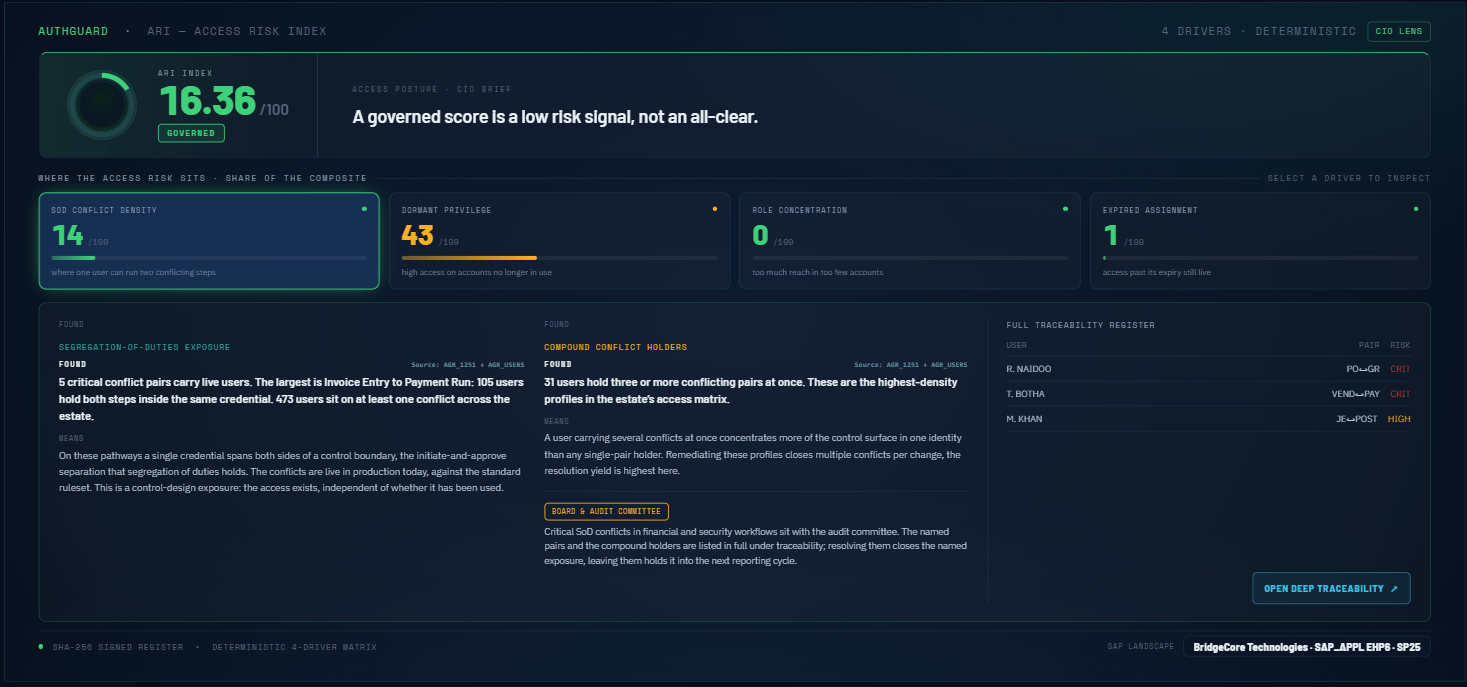
Not ready for a conversation yet?
Run CorePulse™ — your estate's first structural health check, in seconds.

A small set of standard SAP transaction exports. No collector. No system access. No conversation required. Upload via a secure portal — CorePulse™ computes your Health Check SCI and generates a signed Estate Health Report in seconds. You receive a plain-language Gap Statement and complexity band classification — GOVERNED, MANAGED, AT_RISK, or CRITICAL — that you can put in front of your board or use to start the conversation internally. The upload key is invalidated after the first run. Your files are purged immediately after processing.

Learn About CorePulse™ →
Commitments
Pitch you a target architecture on the first call.
Bring account managers to a technical conversation.
Produce a report that creates more questions than it answers.
Tell you to migrate before you understand what you are migrating.
One way to start.
Responded to within one business day.

Confidentiality is a default, not a request. No account managers. No pitch deck.

Latest from
The STRATA™ Intelligence
View all articles & case studies →
Latest from
The STRATA™ Intelligence
View all articles & case studies →
Insight March 2026
Before You Approve the S/4HANA Programme:
What the Structural Assessment Reveals

Most S/4HANA programmes are approved on business case, commercial proposal, and delivery confidence. None of those inputs contain a structural assessment of the ERP estate the programme is about to transform. This is the single most preventable cause of cost overrun in enterprise ERP transformation.

Insight March 2026
The 20-Year SAP Estate:
What Two Decades of Customisation Has Actually Built

Every year of ERP operation adds objects, integrations, and workarounds that compound quietly. By year twenty, the estate your organisation depends on is structurally unrecognisable from the system that was implemented. This is what STRATA™ finds — and what it resolves.

Insight January 2026
Your IT Backlog Is an Architecture Problem, Not a Capacity Problem

Adding developers to an IT backlog that is caused by ERP core dependency is like adding lanes to a road that ends at a wall. The constraint is architectural. The solution is Edge™.

Insight March 2026
The Stay-and-Thrive Stack:
How Governed ERP Estates Outperform Migration Programmes

Thousands of enterprises are running mature ERP estates under end-of-maintenance pressure. Most believe their only options are migrate or fall behind. This paper argues for a third path — structural governance, extended technical support, and modern capability delivery above the core — that outperforms both alternatives on cost, risk, and operational continuity.

We use cookies and analytics to understand how visitors engage with this site — page views, scroll depth, and content interactions. No personally identifiable information is collected or shared. Privacy Policy